- Published on
Done Isn't the Goal
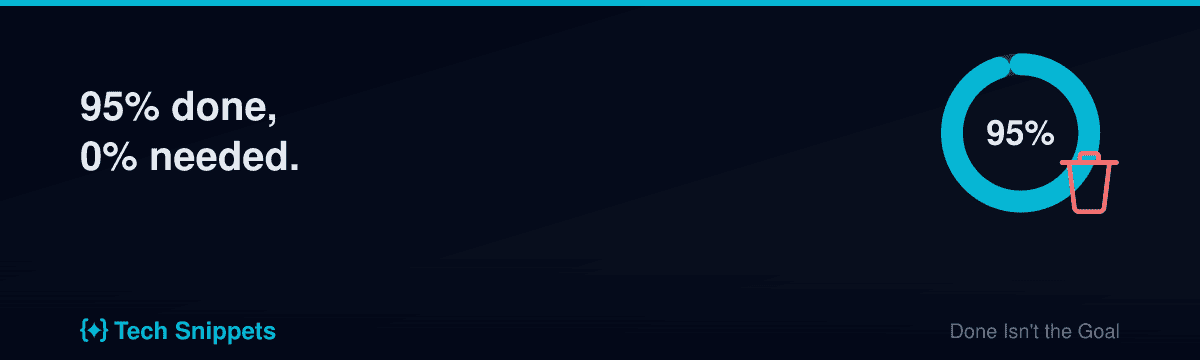
A team I knew shipped the final five percent of a project the company had already moved on from. They'd been heads-down for months, the launch was close, and finishing felt like the responsible thing to do. It wasn't. By the time it shipped, the goal it served had quietly been retired two reorgs ago. The work was good. The aim was wrong. Nobody used it.
Goals are not fixed stars you can sight once and forget. The nimble companies reset them on a cadence — every quarter, sometimes faster — because the world they're betting against keeps moving. And the ones that aren't nimble aren't stable either; they just drift more quietly. The goal on the slide stays the same, but the interpretation of what actually matters underneath it shifts from leader to leader, meeting to meeting. Either way, the target you locked onto at kickoff is rarely the target by the time you're done.
That makes staying aligned a continuous act, not a one-time briefing. Whether you're running an org or shipping code as an individual, part of the job is keeping live tabs on the goal — talking to leadership often enough to catch the priorities shifting, and auditing your own interpretation against theirs before it hardens into assumption. Alignment decays. You have to keep re-checking it, the way you'd re-check a compass on a long hike, not glance at it once at the trailhead and trust it for the rest of the day.
The wrong way to handle a moving goal is to not handle it at all — to keep your head down and grind, telling yourself that finishing is its own virtue. Two forces push you there. One is sunk cost: we've put six months into this, we can't stop now. The other is plain inertia: the project has momentum, the meetings are already on the calendar, and turning the ship feels harder than sailing it into the rocks. Both are traps, and both feel like diligence from the inside.
Here's the uncomfortable math. A project that's ninety-five percent finished but no longer serves the org is not worth ninety-five percent of something — it's worth almost nothing. Value isn't measured by how close you are to done; it's measured by whether anyone needs the done version. If an honest reassessment says no, the right move is to drop it, yes, at ninety-five percent, and put that last sprint somewhere that counts. The six months are gone whether you finish or not. The only live question is what the next month buys you.
That's the whole discipline, and it's harder than it sounds, because it asks you to waste visibly. Finishing the wrong thing looks like productivity; killing it looks like failure — right up until everyone realizes it was the smartest call in the room. So keep asking the only question that matters: does this still serve the goal as it stands today, not the goal as it stood when we started? Talk to the people who set the target. Check your aim against it, often. And when the honest answer is no, have the nerve to stop. A finished project nobody wanted is just expensive inertia with a launch date. Done was never the goal. Useful was.