- Published on
Forward Deployed
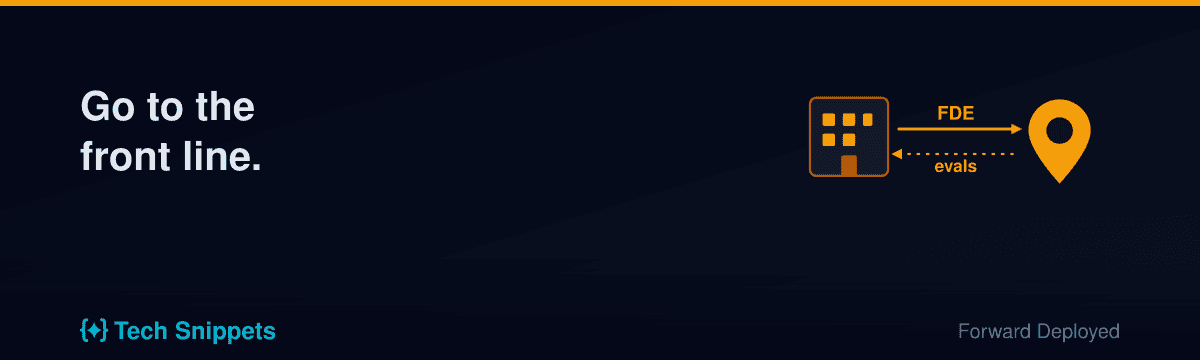
There's a job title spreading through the best AI companies that sounds like it belongs in the army: the forward deployed engineer. Palantir coined it years ago and built a company on it, and now OpenAI, Anthropic, and a wave of startups are hiring for it as fast as they can. The easy reaction is to roll your eyes — a fancy new name for a consultant, or a solutions engineer with a nicer title. That misses the one thing that makes the role different. A consultant advises and leaves; a sales engineer demos and moves on. A forward deployed engineer embeds. They don't visit the customer — they join them.
Embedding is literal. The FDE gets a seat in the customer's Slack, sits in their standups, and learns the domain well enough to argue about it — the weird edge cases, the regulatory landmines, the workflow everyone hates and nobody documented. Out of that immersion comes something no spec can give you: product sense for a problem that isn't yours, and the empathy to build a solution the customer will actually adopt instead of one that merely demos well. They write real production code, inside someone else's reality, and they ship it where the work happens.
This matters more for LLMs than for almost anything that came before, because a frontier model is fundamentally one-size-fits-all. The intelligence is general; the value is entirely in the fit — and the fit is hard. Every customization runs straight into a company's privacy constraints, the private data it can't send anywhere, and endless prompt and agent tuning to make the thing behave on their particular task. Someone has to be on the inside to do it. There's also a quieter reason the model companies love the arrangement: a good FDE builds evals — concrete definitions of what "working" means for that customer — and the best contracts let those evals flow back to core research to train the next model. In the end, data is the raw material of a better LLM, and the front line is where the real data lives.
In an era of small, talent-dense teams, the FDE is how you cover the last mile without hiring a thousand people to sit in a thousand accounts. And they're deliberately movable: a deployment tends to run three to twelve months, after which they rotate — back to core engineering for a while, then out to the next customer. That rotation is the whole point. It stops them from calcifying into a permanent contractor bolted to one client, and it turns every engagement into something the core product learns. Done badly, forward deployment is an expensive consulting shop reinventing the same integration forever. Done well, the bespoke work shrinks with each rotation while the platform grows underneath it.
Which is why the army metaphor fits better than the consulting one. A consultant's job is to leave; the forward deployed engineer's job is to bring something back. They go to the front, learn the ground truth, ship where the problem lives, and carry it home to make the product — and the next model — better. For a decade we told engineers that leverage meant scale: build the platform, let a million users self-serve, and never get pulled into any one customer's problem. The forward deployed engineer is the bet that, in the AI era, the opposite is true.