- Published on
Have and Eat Your Cake!
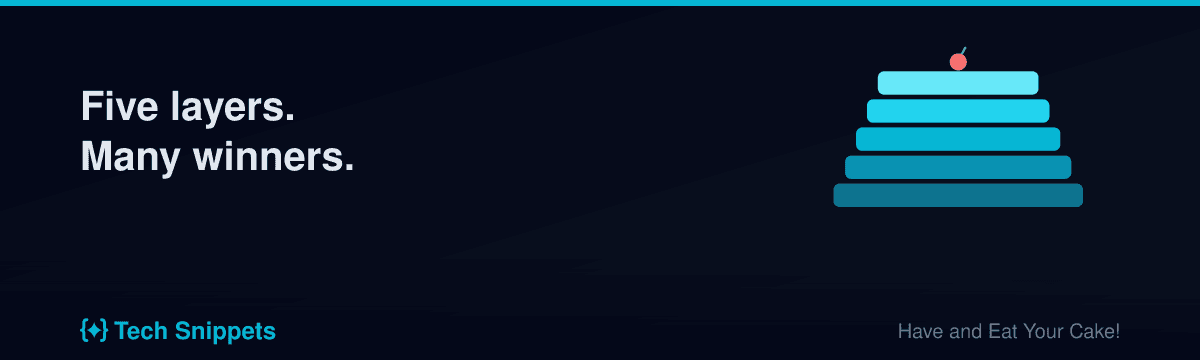
One of the best habits in building software is to think of the stack as a layer cake. You slice a sprawling, tangled system into clean horizontal layers, each with a single job and a clear contract to the ones above and below it. It sounds like bookkeeping, but it does real work: it forces modularization, it assigns unambiguous ownership so a team knows exactly what it's responsible for, and — most usefully — it shows you where the whole thing is starving. Stack the layers and the bottleneck reveals itself, whether it's a slow tier of infrastructure or a thin tier of people. You can't optimize what you can't see, and the cake makes the stack legible.
Recently Jensen Huang, Nvidia's CEO, used exactly this framing to describe AI — a five-layer cake he laid out at Davos this year. From the bottom up: energy, chips, infrastructure, models, and applications. The point of the metaphor is a little subversive. We keep talking about AI as a software story, but Huang's cake reframes it as an infrastructure story, where every clever application at the top is quietly pulling on every layer beneath it, all the way down to the power plant. It's also why the market's favorite acronym is changing. FAANG described an attention economy — companies competing for your time. Its successor, MANGOS — Meta, Anthropic, Nvidia, Google, OpenAI, SpaceX — describes an infrastructure economy, companies selling the layers everyone else runs on.
The bottom layer is energy, because real-time intelligence needs real-time power, and a data center is now sized in gigawatts before it's sized in teraflops. This is the layer big tech is scrambling to lock down — Microsoft, Amazon, and Google signing nuclear deals, restarting reactors, and building next to power plants — because compute you can't power is worthless.
Above energy sit the chips, whose only job is to turn watts into computation as efficiently as possible. This is Nvidia's layer, so completely that its name anchors the new acronym; the challengers are the hyperscalers building their own silicon — Google's TPUs, Amazon's Trainium, OpenAI's freshly announced inference chip — all trying to escape paying Nvidia's margin.
The middle layer is infrastructure: the networking, cooling, and systems software that makes tens of thousands of chips behave like one machine. A GPU on its own is a paperweight; the value is in wiring them together at scale. This is the cloud layer, owned by Amazon, Microsoft, and Google, with Nvidia steadily pushing up into it through its networking stack.
Then come the models, the layer that turns raw compute into something that can reason, write, and see. This is the most crowded and fastest-moving tier — OpenAI, Anthropic, Google, and Meta trading the lead every few months — and the one where a big model's edge can be copied by a smaller one almost as fast as it's built.
At the top are the applications, the only layer most people ever touch — the chat box, the coding assistant, the search that answers instead of linking. It's the easiest layer to enter and the hardest to defend, since anyone can build on the models below. Microsoft, Google, and Meta ship apps to billions, while a thousand startups race to own a niche before a model provider simply absorbs it.
Every layer of the cake matters, and a weakness in any one starves the rest. But the real lesson is vertical. The player who can ruthlessly own, build, and optimize across all five — power to chips to infrastructure to models to apps — controls its own costs at every step and keeps the margin everyone else has to pay out. That's the game the MANGOS are all quietly playing. The old proverb says you can't have your cake and eat it too. Own all five layers, and you can.