- Published on
Loosen the Harness
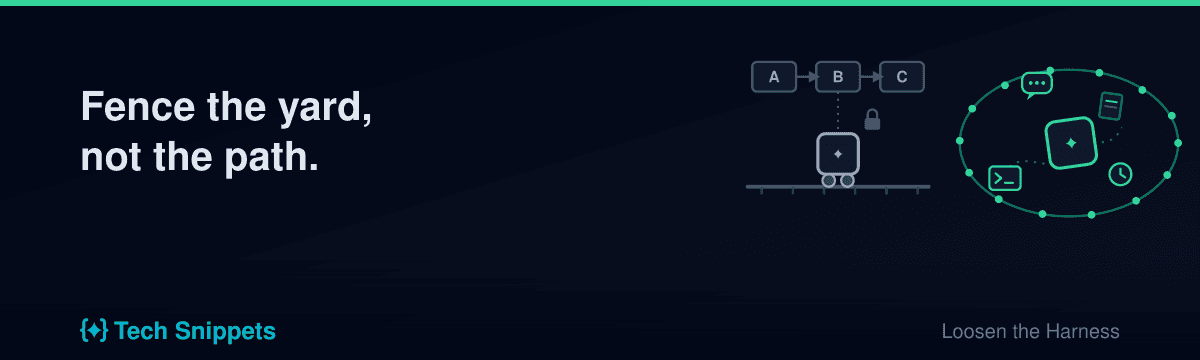
Every AI product you use is a model in a harness, and mostly the same few models. So the real difference between products is not intelligence — it's rope. Traditional AI ships a tight harness: the vendor draws the workflow and the model fills a slot in it. The agents everyone installed on their own machines this year — OpenClaw, Hermes — ship a loose one: here's a computer, here's a chat channel, figure it out. The two designs disagree about one thing only: how much you trust the model.
A tight harness encodes distrust, mostly for good reasons. The support bot follows a script; the enterprise copilot retrieves from an approved corpus; the workflow engine runs step A, then B, then C, with an approval gate before anything irreversible. Enterprises are converging on exactly this — supervisor patterns, phase gates, bounded workflows — because when the stakes are real you want determinism. The model is an actor on rails. Nothing terrible happens. Nothing unscripted happens either.
A loose harness encodes trust. OpenClaw — the project Nvidia called the operating system for personal AI — is barely a workflow at all: a gateway that connects WhatsApp and iMessage to a loop with shell access, a browser, cron jobs, and memory kept as plain markdown files on disk. Hermes, from Nous Research, goes a step further: when it completes a hard task, it writes itself a reusable skill, growing its own harness. Nobody drew a flowchart. The product is mostly rope, and the model decides what to do with it.
Why would anyone choose the loose design? Because tight harnesses age badly. A workflow is a snapshot of what today's model can't be trusted to do, and models keep improving. Every upgrade makes the scaffolding more of a bottleneck, until the flowchart that once protected you is just a cap on the ceiling. The loose harness rides the same upgrade for free — the day a better model ships, the same product gets smarter overnight. Tight caps the agent at its author's imagination; loose caps it at the model's ability.
The bill for loose arrived on schedule: more than forty thousand OpenClaw instances exposed on the internet, a single crafted email exfiltrating SSH keys, a fifth of the community skill registry turning out to be malware. None of it was the model misbehaving — it was rope handed out faster than fences went up. And notice what the fix looked like: not more flowchart, but more boundary — command allowlists, approval prompts, audit logs. Safety that lives in the workflow dies with the workflow; safety that lives at the boundary survives any behavior the model invents.
So loosen the harness as fast as your blast radius allows. Fence the yard, not the path — and let the model surprise you inside it.